How Electric Reefers Work: A Comprehensive Guide
Electric refrigerated trailer units (TRUs) and diesel TRUs do the same job using the same underlying technology — the vapor-compression refrigeration cycle. Both move heat out of an insulated trailer and eject it to the outside air. The only meaningful difference is what powers the compressor and fans: electric TRUs use AC power from the grid, diesel TRUs use a small internal combustion engine.
Understanding what’s inside an electric TRU — and how the components work together — makes it easier to evaluate whether one fits your operation.
Main Takeaways
- Electric and diesel TRUs use the same refrigeration cycle; only the power source differs
- Electric TRUs require three-phase AC power (220–240V or 440–480V) and must remain plugged in to operate
- The system has fewer moving parts than a diesel TRU and substantially less maintenance overhead
- Performance is functionally identical to a modern diesel TRU within the temperature range of -20°F to +80°F
- Compression. The compressor pressurizes refrigerant gas, which raises its temperature.
- Condensation. Hot, pressurized gas flows to the condenser coil mounted on the outside of the trailer. Air blown across the coil carries heat away, and the gas condenses into a warm liquid.
- Expansion. The high-pressure liquid passes through an expansion valve, where its pressure drops sharply. The fluid becomes very cold.
- Evaporation. The cold fluid flows through the evaporator coil inside the trailer. Air blown across the coil transfers heat from inside the trailer into the refrigerant, which evaporates back into a low-pressure gas. The cycle then repeats at the compressor.
The net effect: heat is continuously moved out of the trailer and rejected to the outside air, holding the cargo space at the set point.
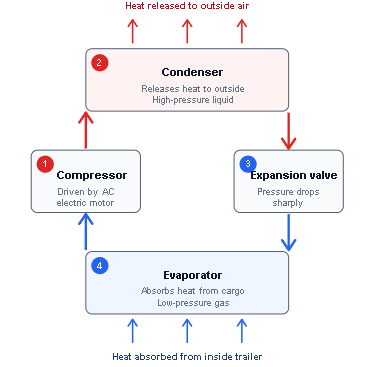
Refrigeration components
These four components handle the cycle itself. They are common to both electric and diesel TRUs — what changes between the two is how they’re driven.
Compressor
The compressor is the heart of the system. In an electric TRU, it’s driven by an AC electric motor connected directly to shore power. In a diesel TRU, it’s driven by a belt off the diesel engine. The electric version has fewer wear components and runs at more consistent RPM, which improves efficiency and reduces noise.
Condenser coil and fan
The condenser sits on the exterior of the unit and rejects heat to the outside air. A fan driven by an AC motor pulls air across the coil to carry that heat away. The coil and fin geometry are the same as in any commercial trailer reefer — only the fan motor differs.
Expansion valve
A small mechanical or electronic valve that drops the refrigerant from high pressure to low pressure as it passes through. This is what makes the refrigerant cold enough to absorb heat from inside the trailer. The expansion valve is purely mechanical and identical between electric and diesel units.
Evaporator coil and fan
The evaporator sits inside the cargo space. As cold refrigerant flows through the coil, the fan circulates air across it, picking up heat from the cargo and the trailer interior. The fan also ensures uniform airflow around the load, which is critical for maintaining temperature consistency throughout the trailer.
| Specification | Requirement |
|---|---|
| Power type | 3-phase, 50–60 Hz |
| ER-230 voltage | 220–240V, dedicated 60-amp circuit |
| ER-460 voltage | 440–480V, dedicated 30-amp circuit |
Electric power module
The power module is the unit’s electrical front-end. It conditions incoming power, protects against surges and miswiring, and manages the contactors and relays that switch the compressor and fan motors on and off. It includes:
- Power inlet with circuit protection
- Contactors and relays for switching motor loads
- Capacitors or soft-start equipment to reduce inrush current at startup
- Disconnect switch for safe service access
Digital control system
The control system is the brain of the unit. It takes the operator’s set point, monitors actual temperature inside the trailer, and cycles the compressor and fans on and off as needed to maintain target. Controls run on low-voltage AC, not the 12VDC found on diesel units.
Standard control functions include:
- Temperature set point adjustment
- High and low temperature alarms
- Automatic defrost cycles
- Remote monitoring (model-dependent)
Putting it All Together
Power flows from the shore power connection, through the electric power module, to the AC motors that drive the compressor and the two fans. The digital controls watch the cargo space temperature and switch the compressor on and off to maintain the set point. The refrigeration loop runs continuously while the compressor is energized, moving heat out of the trailer and rejecting it to the outside air.
The fundamental advantage of the electric design isn’t the refrigeration cycle — that’s identical to a diesel unit. It’s the elimination of the diesel engine. Removing internal combustion removes the vast majority of moving parts, the fuel system, the exhaust aftertreatment, and the routine service intervals that come with all of that. What remains is a refrigeration system driven by electric motors that have no scheduled maintenance beyond a drive belt every five years.
Electric TRUs are purpose-built for stationary applications — storage trailers, dock-side cooling, yard staging, and overflow capacity. They’re a strong fit if:
- Your trailers stay parked while refrigerated
- You currently run aging diesel TRUs (Thermo King, Carrier, or otherwise) with rising maintenance costs
- Your facility has or can support three-phase electrical service
- You’re looking to reduce noise, emissions, or fuel logistics overhead
They are not suitable for over-the-road transport, where the trailer needs refrigeration while moving. Diesel and hybrid units remain the standard for that use case.
If your operation matches the stationary profile, the next step is matching the right unit to your trailer count and electrical service.